

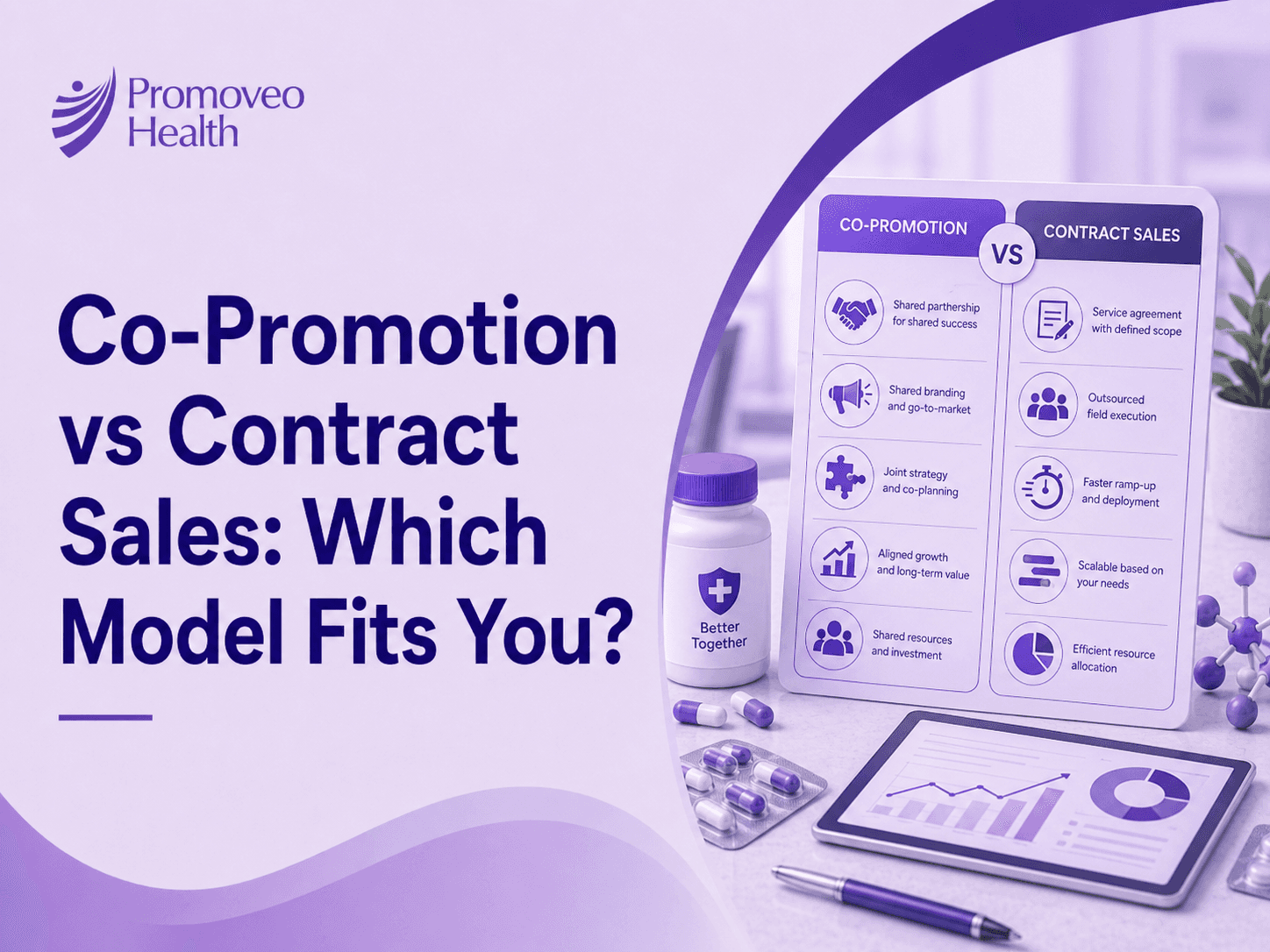
When a pharma or biotech company needs to grow its field presence, two options come up more than any other: co-promotion and contract sales. Both get your product in front of healthcare providers. Both use experienced sales reps. But the way they work, what they cost, and what they give you in return are very different.
Picking the wrong model does not just waste budget. It can slow your launch, dilute your brand message, and leave your product sitting in second place in someone else's bag.
This blog breaks down both models honestly so you can figure out which one actually fits your situation.
What Is Co-Promotion?
Co-promotion is a partnership arrangement where two companies agree to jointly promote a product through their respective sales forces. Usually, one company owns the product and the other provides field reps who sell it alongside their own portfolio.
It sounds attractive on paper. You get immediate access to an established salesforce with existing HCP relationships and territory coverage, without building a team from scratch.
But here is where it gets complicated. In a co-promotion deal, your product is one of several in that rep's bag. Their primary loyalty is to their employer, not to your brand. Their call priorities, their time with physicians, and their selling energy are shared resources. When your product competes with their own for attention, yours tends to lose.
Co-promotion works in specific situations. It works well when both companies have truly complementary products, when the partner's reps already call on your exact target physicians, and when your brand can hold its own without being the centerpiece of every sales conversation.
Outside of those conditions, the model creates more friction than it removes.
What Is Contract Sales?
A contract sales organization, or CSO, builds and manages a dedicated field team exclusively for your product. The reps work under your direction, carry your brand, and spend 100 percent of their selling time focused on your commercial objectives.
Unlike co-promotion, there is no shared bag. No competing priorities. No wondering whether your product got the attention it deserved in today's physician calls.
The reps are fully trained on your therapy area, aligned to your culture, and accountable to your performance metrics. A good CSO partner also handles recruiting, onboarding, compliance training, and field management, so you get the output of a fully built salesforce without the overhead of building one internally.
For companies working with contract sales teams , the key advantage is control. You define the strategy. You set the targets. You own the results.
Co-Promotion vs Contract Sales: A Direct Comparison
Brand Focus and Rep Loyalty
In co-promotion, your brand shares attention with the partner's existing products. Reps prioritize what their employer incentivizes, and that is rarely your product first.
In contract sales, reps are hired specifically for your brand. Your product is their entire job. The difference in focus shows up in call quality, physician conversations, and ultimately in prescription growth.
Speed to Market
Co-promotion can move quickly if a partner with an existing salesforce is already in place. But finding the right partner, negotiating terms, aligning on compliance, and training their reps on your product still takes significant time.
Contract sales through an experienced CSO can get a field-ready team deployed in as few as three weeks when the partner has a proven recruitment and training infrastructure. For launch-stage companies, that speed is often the deciding factor.
Cost Structure
Co-promotion deals typically involve revenue sharing arrangements. You give up a percentage of sales in exchange for field coverage. In early growth phases when revenue is still building, that trade-off can get expensive fast.
Contract sales converts your salesforce cost into a more predictable, manageable operating expense. You pay for the team and the infrastructure, but you keep your revenue and maintain full control over how success is defined and measured. Companies also avoid the recruiting costs, HR overhead, and benefits administration that come with building an internal team.
Control Over Strategy and Messaging
This is where the two models diverge most sharply. In a co-promotion arrangement, your messaging strategy has to work within your partner's existing framework. You are not running the show.
With a dedicated contract sales team , you control brand messaging, call strategy, territory priorities, and performance standards from day one. If market conditions shift or your strategy needs to change, you make that call. You do not need a partner's approval.
Accountability and Performance Visibility
Co-promotion reporting depends heavily on what your partner shares with you and when. You are working with their data, their timelines, and their interpretation of what constitutes a good result.
Contract sales gives you direct visibility into field activity, HCP engagement, and prescription trends. A strong CSO partner integrates real-time data and reporting tools so you always know exactly what is happening in the field and can act on it quickly.
When Co-Promotion Makes Sense
Co-promotion is worth considering when your product genuinely complements a partner's existing portfolio and their reps already have established access to your target physicians. It can also make sense for lifecycle management situations where a mature product needs supplemental coverage without major investment.
Here is where co-promotion tends to work:
- Your target HCP audience overlaps almost entirely with the partner's existing call universe
- The product requires minimal differentiated selling and fits naturally alongside the partner's portfolio
- You need supplemental geographic coverage rather than a primary field force
- Budget constraints make a fully dedicated team impractical in the short term
When Contract Sales Is the Better Fit
Contract sales through a specialized CSO is the stronger choice for most pharma, biotech, and medical device companies at key commercial moments. It fits particularly well when:
- You are launching a new product and need a dedicated team that lives and breathes your brand
- Your therapy area requires deep clinical knowledge that generalist reps in a shared bag cannot deliver
- You need coverage flexibility as your commercial footprint grows or shifts
- You want full control over strategy, messaging, and performance standards without a partner's constraints
- You are entering a specialty, rare disease, or medical device market where HCP relationships and clinical credibility matter enormously
For companies in the medical device space specifically, purpose-built medical device contract sales teams bring facility access expertise, IDN navigation capabilities, and clinical acumen that a co-promotion partner's generalist reps simply cannot match.