
If you are evaluating contract sales organizations for your pharma, biotech, or medical device brand, you have probably noticed that most of them look very similar on paper. Same promises. Same buzzwords. Same pitch decks.
But once you actually work with a traditional CSO, the cracks start to show fast. Rigid structures, slow decision-making, and a model that was never really built around your brand. That is the experience dozens of life science companies have walked away from before finding a better path.
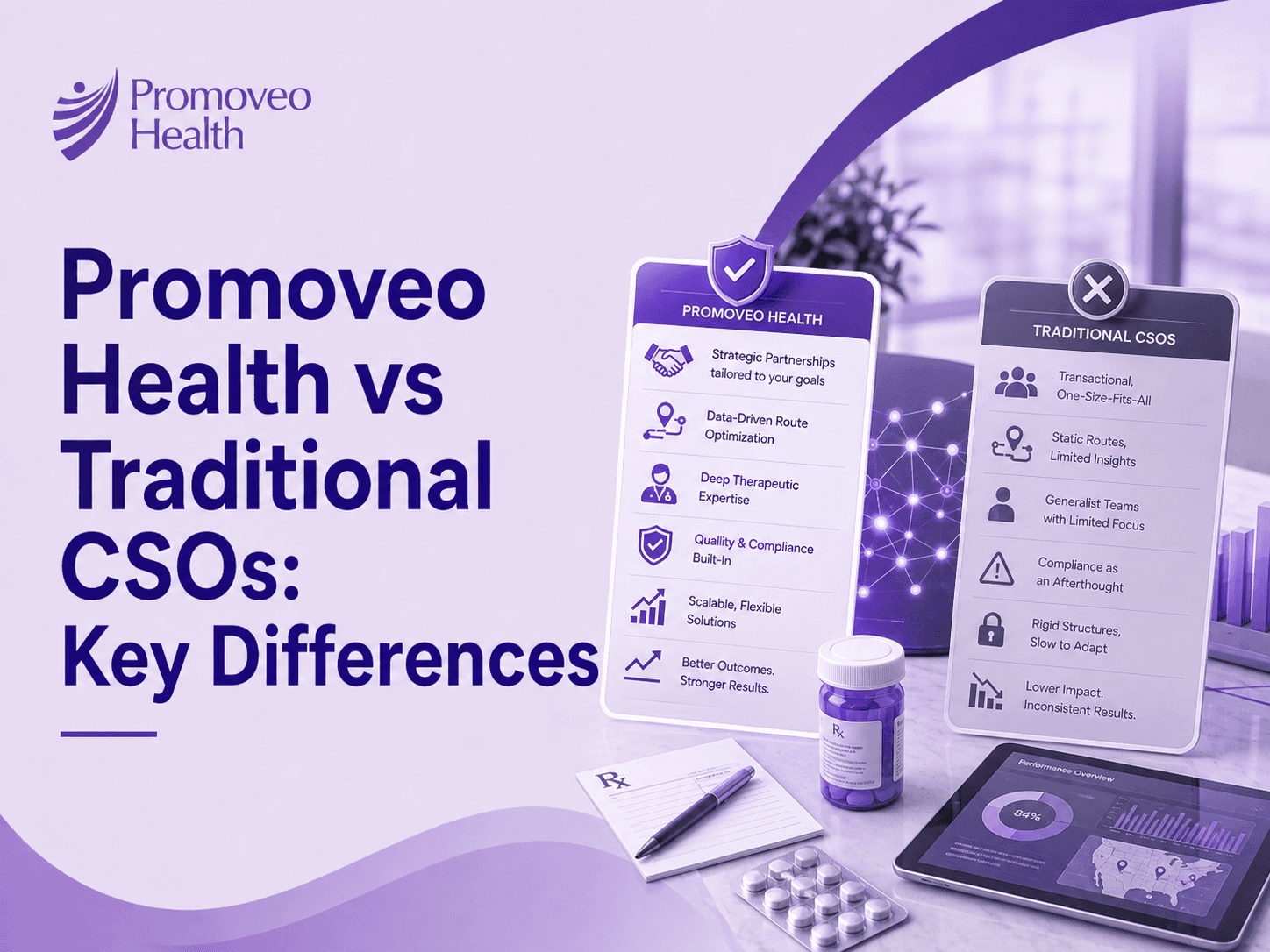
This blog breaks down exactly how Promoveo Health operates differently from traditional contract sales organizations, and why those differences translate directly into better commercial outcomes for your product.
What Is a Traditional CSO and Where Does It Fall Short?
A traditional contract sales organization provides outsourced sales representatives to pharmaceutical and medical device companies. The concept is sound. Outsourcing your field force saves time, reduces fixed costs, and gives you access to experienced reps without building internal infrastructure from scratch.
The problem is not the model. The problem is how most large, legacy CSOs execute it.
Traditional CSOs were built for a simpler era of pharma commercialization. Large brands. Big territories. High rep volumes. That environment rewarded scale, and these organizations built themselves around it. Processes grew heavy. Flexibility became an afterthought.
Today's market is very different. Specialty therapeutics, rare disease launches, and niche HCP targets require speed and precision. Here is where most traditional CSOs consistently fall short:
- Deployment timelines stretching three to six months, leaving your product without coverage during the most critical launch window
- Rigid long-term contracts that penalize you for scaling down as your commercial needs evolve
- Multiple account contacts with no single owner, making accountability confusing and problem resolution slow
- Activity-based reporting that tracks calls and samples but never ties field effort to actual prescription growth
- Reps spread across multiple brands, reducing the clinical depth your product actually needs
These are not occasional complaints. They are patterns that come up repeatedly from companies that have been through the traditional CSO experience.
Key Differences: Promoveo Health vs Traditional CSOs
Speed of Deployment
Traditional CSOs take three to six months to launch a field team. Internal approval layers, standardized onboarding, and volume-focused recruiting pipelines all slow the process down.
Promoveo Health deploys fully trained, brand-aligned contract sales teams in as few as three weeks. Recruiting, training, and compliance preparation run simultaneously rather than sequentially. For a brand preparing a product launch, that difference in deployment speed can represent millions in lost prescription revenue.
Flexibility vs. Rigid Contracts
Most traditional CSOs lock you into fixed headcount, fixed territories, and long-term agreements. Their model depends on predictable revenue. Your evolving needs come second.
Promoveo Health offers flexible engagement models built around where your brand actually is. Dedicated team for a major launch. Hybrid shared model to manage costs during a lifecycle phase. Targeted syndicated approach for white-space coverage. The structure adapts to your commercial strategy, not the other way around.
Single Point of Accountability
Larger CSOs split your program across multiple departments. Account manager, recruiting contact, training coordinator, compliance officer. Each owns a piece. Nobody owns the whole thing. When something goes wrong, finding who is responsible takes longer than fixing the actual problem.
At Promoveo Health, one dedicated account leadership team owns your program from strategy through daily field execution. One contact. Full visibility. Real accountability.
How Performance Is Measured
Traditional CSOs report on activity: calls completed, samples distributed, detail frequency. These numbers fill a dashboard and tell you almost nothing about whether your product is actually growing.
Promoveo Health ties performance directly to your TRx growth objectives. Here is what that looks like in practice:
- Rep incentives are tied to prescription growth targets, not just call volume numbers
- Territory strategy adjusts in real time based on prescribing data, not a quarterly review cycle
- Underperforming areas are identified and addressed within days, not flagged weeks after the gap opened
- Program success is measured by TRx movement and HCP engagement quality, not internal activity metrics
That shift in how success is defined changes how a field team behaves every single day.
Therapeutic Expertise and HCP Access
Legacy CSOs manage dozens of brands across broad therapeutic areas. Reps often carry multiple products and shift assignments based on where the CSO needs coverage, not where your brand does.
Promoveo Health matches reps to your specific therapeutic area. Field teams and inside sales teams bring pre-existing HCP relationships, clinical familiarity, and territory knowledge that would take an internal team years to develop. In specialty and rare disease launches where the target HCP universe is small, every relationship counts.
Who Promoveo Health Is Built For
Promoveo Health works best for pharma brands at critical commercial inflection points. Product launches. Market expansions. Specialty coverage gaps. Situations where speed and precision matter more than scale.
Growing biotech needing rare disease coverage fast. Mid-size pharma looking to reduce salesforce overhead without losing field presence. Medical device company trying to break into hospital systems. Promoveo Health was built with those situations in mind, including specialized medical device contract sales capabilities across therapeutic areas that legacy CSOs typically underserve.
Frequently Asked Questions
What is the biggest practical difference between co-promotion and contract sales?
Co-promotion shares rep attention across multiple products in a bag. Contract sales gives you a dedicated team focused entirely on your brand. The accountability and focus levels are completely different.
Which model is more cost-effective for an early-stage biotech?
Contract sales is usually more predictable. Co-promotion involves revenue sharing that gets expensive as sales grow. A contract model converts cost into a manageable operating expense you control.
Can I switch from co-promotion to contract sales later?
Yes, and many companies do. Co-promotion often serves as a bridge while a dedicated contract sales infrastructure is being built. Timing and HCP relationship continuity need careful planning during the transition.
How quickly can a contract sales team be deployed compared to setting up a co-promotion deal?
A good CSO deploys a field-ready team in three to eight weeks. Co-promotion deals typically take longer once you factor in partner negotiations, compliance alignment, and product training for existing reps.
Does Promoveo Health offer both models?
Promoveo Health specializes in dedicated contract sales teams for pharma, biotech, and medical device. Reach out to the team at Promoveo Health to find the right commercial model for your product.